Could your organisation explain why its AI made an important decision, who approved it and what happens if it fails? As artificial intelligence becomes part of everyday services, these questions can no longer wait. ITIL (Version 5) AI Governance Training helps professionals connect innovation with responsible oversight. It encourages teams to manage AI across products, services and business decisions. Strong governance protects people without blocking useful progress.
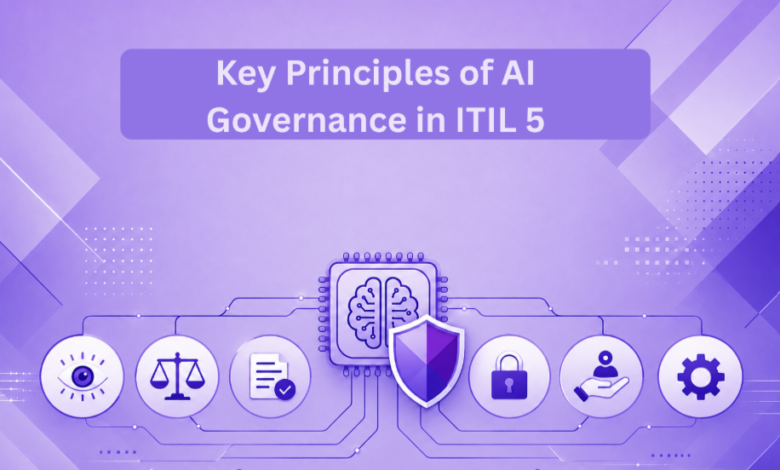
In this blog, we explore seven principles that can make AI systems more transparent, fair, secure and dependable throughout their lifecycle.
Table of Contents
- Seven Principles Shaping Responsible AI in ITIL 5
- Conclusion
Seven Principles Shaping Responsible AI in ITIL 5
The following principles help organisations use artificial intelligence responsibly while protecting people, information and business value:
Transparency
When interacting with an AI system, people ought to be aware of it. Organisations need to be transparent about the applications and functions of AI. This covers hiring, fraud detection, customer service, and automated suggestions.
Teams must additionally record data sources, system goals, and important constraints in order to maintain strong AI transparency. Users shouldn’t have to question if a choice was made by a machine or by a human. Clear communication fosters confidence and enables stakeholders to voice concerns when an AI result seems unfair or inaccurate.
Explainability
An AI system might respond swiftly, but can the company explain why? Explainable AI transforms ambiguous outputs into comprehensible information. Teams ought to be able to explain the elements that went into a recommendation or choice.
The degree of danger and the amount of explanation should be equal. A recommendation for music might not require much information. However, a judgement made by AI that impacts healthcare, finance, or employment requires a much more thorough justification. ITIL (Version 5) AI Governance Training helps professionals understand how clear explanations can support trust, risk management and better customer outcomes.
Accountability
AI can help with decision-making, but people still need to be in charge. Every AI system should have a clear owner assigned by the organisation. These owners must be aware of their responsibilities and possess the power to resolve issues.
Clear reporting procedures, frequent evaluations, and approval procedures are also necessary for effective AI accountability. Teams need to know who will look into and take action if an AI system damages people or yields inconsistent outcomes. ITIL (Version 5) AI Governance Training can help organisations establish clear roles for monitoring AI systems and managing their results.
Fairness
Individuals and demographic groups should be treated equally by AI systems. However, inadequate data, previous actions, or bad design choices might introduce biased tendencies into a model. To find and lessen detrimental bias, teams must test systems on a regular basis.
It takes more than just testing a model before it is released to support ethical AI. Throughout its use, organisations should keep an eye on the results. When examining the results, they must also include individuals with diverse backgrounds. Individual rights are respected and specific populations are not disadvantaged by a just system.
Privacy and Security
AI systems frequently rely on vast volumes of data. Sensitive or private information may be included in some of this data. Organisations must only gather what they require and provide a clear explanation of how it will be utilised.
Controlled access, safe storage, and cautious data exchange are examples of robust data privacy protections. Additionally, teams should guard AI systems from information breaches, unauthorised modifications, and cyberattacks. ITIL (Version 5) AI Governance Training supports a structured understanding of the controls needed to protect sensitive information. Privacy and security reviews must continue after launch because threats, system uses and data sources can change.
Safety and Robustness
An AI system ought to function dependably in both typical and unforeseen circumstances. Teams need to test what occurs when data is erroneous, incomplete, or purposefully deceptive. Before producing harm, the system should either stop or continue to function securely.
Human intervention and backup plans are also essential components of effective AI risk management. Organisations should keep an eye on performance and document any mistakes or odd behaviour. Teams can better grasp system limitations by doing routine testing. Additionally, it shields clients, team, and services against financial, social, digital, and physical harm.
Regulatory Compliance
AI systems have to abide by applicable national and international regulations. Data protection, consumer rights, discrimination, intellectual property, and industry-specific regulations may all be covered by requirements. Before utilising an AI system, organisations should determine which restrictions apply.
Compliance cannot be treated as a single approval process. Laws and regulatory guidance continue to evolve as the use of AI grows. ITIL (Version 5) AI Governance Training helps professionals connect changing requirements with suitable governance controls. Teams must also maintain accurate records, review systems regularly and update controls when requirements change.
Conclusion
Responsible AI depends on more than powerful technology. Transparency, explainability, accountability, fairness, privacy, security, safety and compliance turn broad promises into practical action. These principles help organisations protect people while gaining genuine value from AI.
Professionals can explore ITIL 5 Training to strengthen their understanding of governance, risk and responsible digital services. The result is not simply better control, but AI that people can trust, question and improve with confidence.